
Work Smarter, Not Harder: How Remote Jobs Can Save You Time and Money
Somewhere between the third alarm snooze and the mad dash for the train, most office workers have had the same thought: there has to be a better way to do this. Turns out, there is, and it starts with a simple truth: remote jobs save time in ways a traditional office job never can. It isn’t about squeezing more hours out of your day or grinding harder until you burn out. It’s about working smarter, and for millions of people, that means going remote.
Remote jobs aren’t just a pandemic-era leftover that refused to die. They’ve become a permanent, data-backed shift in how people build careers. As of March 2026, https://www.bls.gov/opub/ted/2026/22-6-percent-of-workers-teleworked-in-march-2026.htm reports that 22.6% of the U.S. workforce teleworked or worked from home for pay, a rate that’s held steady for years despite loud return-to-office headlines. That’s not a fluke. It’s proof that remote jobs save time and money in ways most people don’t fully calculate until they try it.
Let’s break down exactly how.
What “Work Smarter, Not Harder” Actually Means for Remote Jobs
The phrase gets thrown around a lot, usually in motivational posters next to a stock photo of a mountain. But in the context of remote jobs, it has a very literal meaning: you get the same (or better) output while removing the friction that used to eat your day alive.
Think about everything a traditional office job demands before you even open your laptop:
- Getting dressed for an office, not just a webcam
- Commuting through traffic or public transit
- Buying lunch because meal-prepping around a commute is hard
- Paying for parking, gas, or transit passes
- Losing hours to hallway chit-chat and unnecessary meetings
None of that adds value to your actual work. It’s overhead, the human version of a company paying rent on office space it barely uses. Remote jobs strip that overhead away, which is exactly why “working smarter” isn’t a cliché here. It’s a measurable outcome.
How Remote Jobs Save You Time Every Single Day
Time is the one resource you can never buy back, and this is where remote jobs save time most dramatically, starting with the commute. According to Owl Labs’ https://resources.owllabs.com/state-of-remote-work research, remote workers save an average of over an hour a day by cutting out the commute entirely, and a meaningful chunk of that reclaimed time goes straight back into focused work rather than sitting in traffic.
Here’s what that actually looks like over a year:
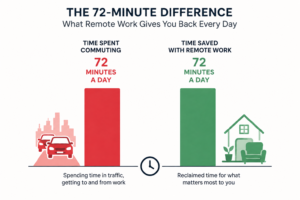
- 72 minutes saved daily from skipping the commute
- That adds up to roughly 300+ hours a year, the equivalent of nearly eight full 40-hour work weeks
- Workers redirect a large share of that time into actual productive work, not just extra scrolling
- Fewer in-office interruptions mean deeper focus blocks and fewer context-switches
And it’s not just about the commute. Remote jobs also cut down on:
- Meeting bloat, fewer “let’s grab everyone in a room” meetings that could’ve been an email
- Prep time, no ironing shirts, no packing a bag, no rushing out the door
- Recovery time, less commute-induced fatigue means you actually have energy left for your evening
When you stack all of that together, remote jobs don’t just save you minutes here and there. They hand back entire chunks of your week that you get to spend however you want, with family, on a side hustle, or just recovering some sanity.
How Remote Jobs Save You Money (The Numbers Might Surprise You)
This is where remote jobs really start to shine, especially if you’re job hunting with your budget in mind. The savings aren’t hypothetical, they’re consistently backed by independent research year over year. It’s a simple equation: fewer hours lost to logistics means remote jobs save time, and that saved time consistently converts into saved money.
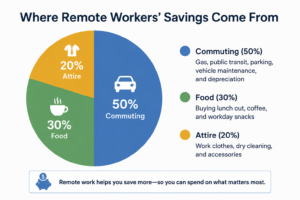
Multiple 2026 surveys put the average remote worker’s annual savings between $2,000 and $12,000, depending on location, commute distance, and lifestyle. That’s a wide range, but even the conservative end is a serious chunk of change most people never account for when comparing job offers.
Here’s where that money actually comes from:
| Expense Category | Traditional Office Job | Remote Job | Estimated Annual Savings |
|---|---|---|---|
| Commuting (gas, transit, parking) | $2,000–$5,000/year | $0 | Up to $5,000 |
| Work attire & dry cleaning | $500–$1,500/year | Minimal | Up to $1,500 |
| Daily lunches & coffee runs | $2,500–$3,500/year | Home-cooked meals | Up to $3,500 |
| Childcare (partial coverage) | Full-time rates | Often reduced | Varies widely |
| Office “extras” (birthday funds, dress codes) | $100–$300/year | $0 | Up to $300 |
Even hybrid workers see the effect. Owl Labs research puts the daily savings for hybrid employees working from home at around $44 per remote day; money that would otherwise go straight to gas, parking, or a $14 salad you didn’t really want anyway.
It’s not just employees who save, either. Employers cut costs too, often estimated between $6,000 and $11,000 per remote worker annually in reduced real estate, utilities, and turnover costs. That’s part of why remote roles aren’t disappearing, no matter how many “return to office” memos make headlines. It’s simply cheaper to keep good people working remotely than to replace them.
Remote Jobs vs. Traditional Office Jobs: A Side-by-Side Look
Sometimes the clearest way to see the difference is to put it side by side. Here’s how remote jobs stack up against the traditional 9-to-5 office grind on the factors that matter most.
| Factor | Traditional Office Job | Remote Job |
|---|---|---|
| Daily commute | 30–60+ minutes each way | None |
| Work attire | Business casual/formal required | Whatever’s comfortable |
| Meal costs | Frequent takeout/dining out | Home-cooked, budget-friendly |
| Flexibility | Fixed hours, fixed location | Often flexible schedule |
| Talent pool (for employers) | Local only | National or global |
| Reported stress levels | Higher | Lower for most remote workers |
| Productivity (self-reported) | Baseline | Higher for majority of remote workers |
Laid out like this, it’s easy to see why remote jobs keep winning people over. It’s not that office jobs are inherently bad, some people genuinely thrive on structure and in-person collaboration. But for a huge share of the workforce, remote jobs simply remove more problems than they create.
The Hidden Productivity Boost Nobody Talks About
Here’s something that surprises a lot of skeptics: remote jobs don’t just save time and money; they often make people more productive, not less. It seems counterintuitive if your mental image of remote work is someone lounging in bed with a laptop balanced on their stomach. But the research doesn’t back that stereotype.
Large-scale studies tracking hundreds of thousands of remote employees have consistently found that productivity holds steady or increases when people work from home. Some of the reasons why:
- Fewer interruptions. No one’s swinging by your desk “just to chat” for twenty minutes.
- Control over environment. You choose your lighting, your noise level, your chair.
- Energy reallocation. Time that used to go to commuting goes into deep work instead.
- Fewer unnecessary meetings. Remote teams tend to default to async communication, which cuts down on calendar clutter.
None of this means remote jobs are magic. They require discipline, boundaries, and the right tools. But when done well, working smarter isn’t just a nice phrase, it’s a direct result of removing friction from your workday.
Best Types of Remote Jobs for Working Smarter, Not Harder
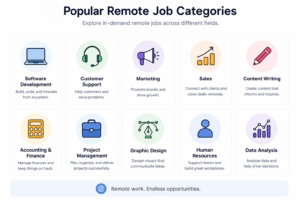
If you’re convinced and ready to start hunting, not all remote jobs are created equal. Some fields lend themselves naturally to remote work because the tasks are digital-first to begin with. A few categories worth exploring:
- Customer support and virtual assistance, high demand, low barrier to entry
- Content writing, editing, and SEO, fully digital output, easy to prove value remotely
- Software development and IT support, some of the highest telework rates of any occupation
- Digital marketing and social media management, client-facing but location-independent
- Bookkeeping and virtual admin support, steady demand across industries
- Recruiting and HR coordination, increasingly hybrid-friendly or fully remote
If your current field doesn’t obviously fit this list, that doesn’t mean remote work is off the table. Many roles that were “always done in-office” have simply never been tested remotely, and more companies are willing to experiment than they were even a year or two ago.
Practical Tips to Make Remote Jobs Work Smarter for You
Landing a remote job is only half the equation. To actually capture the time and money benefits, you need a system. Here’s what separates people who thrive in remote jobs from people who burn out trying:
- Set a firm start and stop time. Without a commute as a natural buffer, work can bleed into your evenings if you let it.
- Create a dedicated workspace. Even a small desk in the corner of a room signals to your brain (and your household) that you’re “at work.”
- Batch your errands and meals. Use the time you’re not commuting to meal-prep or run errands during off-peak hours.
- Track your actual savings. Seeing the real dollar amount you’re saving each month is motivating and helps with budgeting.
- Protect your focus time. Turn off notifications during deep-work blocks, remote jobs give you more control over your calendar than office jobs ever did.
- Invest a little in your setup. A decent chair and monitor pay for themselves fast in comfort and output.
Common Challenges With Remote Jobs (and How to Handle Them)
It wouldn’t be a fair, honest post if we skipped the downsides. Remote jobs aren’t perfect for everyone, and pretending otherwise does you a disservice.
- Isolation. Working alone all day can wear on you. Combat it with regular video check-ins, coworking spaces, or scheduled social time outside of work.
- Blurred boundaries. Without a physical “leaving the office,” work can quietly take over your evenings. Set hard stop times and stick to them.
- Utility costs at home. Some remote workers see a slight bump in home electricity or internet costs, factor this in, though it’s typically a fraction of what you’d spend commuting.
- Career visibility. Remote employees sometimes worry about being overlooked for promotions. Combat this by over-communicating wins and staying visible in team meetings.
None of these are dealbreakers, they’re just things to plan around, the same way you’d plan around any job’s specific quirks.
Final Thoughts: Work Smarter, Not Harder, Starting With Your Next Job Search

The evidence is hard to argue with: remote jobs save time, often close to eight full work weeks a year; and real money, frequently thousands of dollars annually, all without sacrificing productivity. That’s not “working less.” That’s working smarter: cutting out the parts of a job that never actually helped you do your job in the first place.
If you’ve been on the fence about pursuing remote work, let the numbers do the convincing. Your commute isn’t a career requirement. Your lunch budget doesn’t have to be a monthly surprise. And your best work doesn’t need a cubicle to happen.
Start treating your job search the way you’d treat any smart financial decision, by looking at the full picture, not just the salary number. Because sometimes the biggest raise you’ll ever get isn’t a raise at all. It’s simply removing everything that was costing you time and money in the first place.