How to Start a Career in Digital Marketing in 2026: Skills, Jobs, Salaries & Career Path
Somewhere between the third “just get certified” comment on a Reddit thread and the fifth “digital marketing is oversaturated” LinkedIn post, most beginners give up before they even start. That’s a shame, because the truth sits in the middle: yes, more people are chasing a career in digital marketing than ever before. But demand hasn’t slowed down; it’s just gotten pickier about who it hires.
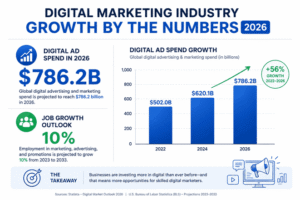
By 2026, global digital advertising spend is expected to close in on $786.2 billion, and marketing job demand is on pace to grow 10%, faster than the average for all careers, according to the Bureau of Labor Statistics data compiled by WordStream. The field isn’t shrinking. It’s specializing. And that’s actually good news for a beginner, because it means there’s a real, learnable path in, not a mysterious door that only “creative types” or marketing majors get to walk through. WordStreamWordStream
This guide walks you through everything: the skills worth learning, the best entry jobs, how to break in without experience, which certifications are actually worth your time, what you can realistically expect to earn, and how to land a remote digital marketing job from wherever you’re sitting right now.
Why a Career in Digital Marketing Still Makes Sense in 2026
Let’s address the elephant in the room: AI has changed digital marketing. AI can write social media captions, generate ad copy, analyze data, and build a content calendar in seconds. So, with tools that can do work that once took marketers hours, why would anyone still choose a career in digital marketing?
Because AI can produce the output, but someone still needs to decide what the business is trying to achieve, who it needs to reach, and whether the strategy actually makes sense. Employers have picked up on this fast. Recruiters increasingly screen for candidates with practical experience in artificial intelligence, personalization, data literacy, data management, Python, and SQL, according to a Coursera breakdown of 2026 hiring signals from staffing agency Addison Group. AI didn’t replace the marketer. It raised the bar for what a competent one needs to know. Coursera
A few other reasons the timing still works in your favor:
- No licensing barrier. You don’t need a government-issued credential to practice digital marketing, unlike law or medicine; employers judge you on portfolio work, results, and demonstrated skill.
- Multiple entry lanes. You can come in through content, SEO, paid ads, email, social, or analytics, whichever matches your natural strengths.
- Remote-friendly by design. Most of the work happens on a laptop, in platforms anyone can access from anywhere.
- Steady long-term demand. Job growth for digital marketing roles is projected at roughly 6% through 2032, slightly above the national average, per Addison Group’s 2026 Workforce Planning Guide. Addison Group
Core Digital Marketing Skills You Need to Learn First
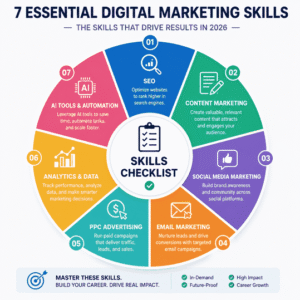
Before you chase a job title, build the underlying skill set. Think of these as your toolbox; every specialization you choose later just means picking up a few extra tools on top of this base.
Foundational skills every beginner should learn:
- Search Engine Optimization (SEO): how content ranks on Google and what makes a page worth clicking
- Content marketing and copywriting: writing that informs, persuades, or sells without sounding like a sales pitch
- Social media management: platform-specific posting, community engagement, and basic paid boosting
- Email marketing and automation: segmentation, sequences, and tools like Mailchimp or HubSpot
- Paid advertising (PPC): running and reading campaigns on Google Ads and Meta Ads Manager
- Analytics and data literacy: reading Google Analytics 4 (GA4) reports and translating numbers into decisions
- Basic AI tool fluency: using generative AI for research, drafting, and campaign optimization without losing your own judgment
You don’t need to master all seven before applying for jobs. Pick two or three that genuinely interest you, get functionally competent, and let the rest develop on the job; that’s how most working marketers actually built their skill stack.
How to Become an SEO Specialist
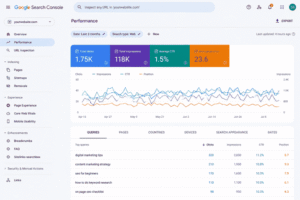
SEO deserves its own spotlight because it’s one of the most in-demand, most beginner-accessible specializations in the entire field, and it pairs naturally with content work, which makes it a strong first specialization.
Here’s a simple path:
- Learn the fundamentals. Understand how search engines crawl, index, and rank pages; keywords, on-page SEO, technical SEO, and backlinks are your starting vocabulary.
- Get comfortable with tools. Spend real time inside Google Search Console, Google Analytics 4, and a keyword research tool like Semrush, Ahrefs, or the free version of Ubersuggest.
- Practice on a real site. Start a niche blog, or offer to optimize a friend’s small business website. Nothing teaches SEO faster than watching your own rankings move.
- Get certified. A free credential like Google’s Skillshop analytics certification adds credibility while you build a portfolio.
- Document your results. Screenshot ranking improvements, traffic growth, and keyword wins; this becomes your proof when you apply for jobs.
SEO specialists are consistently named among the most in-demand digital roles for 2026, alongside market research analysts and digital marketing managers, according to Addison Group’s workforce planning research. If you enjoy a mix of writing, technical problem-solving, and slow-and-steady wins, this is a strong lane to specialize in. Addison Group
Best Digital Marketing Jobs for Beginners
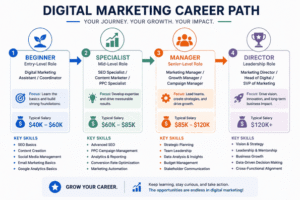
Not every digital marketing job requires five years of experience. Some are specifically built as entry points. Here’s where most successful marketers actually start:
| Beginner Role | What You’ll Do | Skills Needed | Typical Entry Point |
|---|---|---|---|
| Social Media Coordinator | Schedule posts, respond to comments, track engagement | Platform knowledge, basic design, writing | No degree required |
| Content Writer / Blog Writer | Write SEO-optimized articles and web copy | Writing, keyword research, editing | Portfolio-based hiring |
| SEO Executive/Assistant | Optimize pages, research keywords, monitor rankings | SEO basics, GA4, attention to detail | Certification helps |
| Email Marketing Assistant | Build campaigns, manage lists, track open rates | HubSpot/Mailchimp, copywriting | Free certifications available |
| Paid Media Assistant | Support ad campaign setup and reporting | Google Ads, Meta Ads basics | Google Ads certification |
| Marketing Analyst Trainee | Pull reports, track KPIs, spot trends | Excel, GA4, basic data skills | Analytical mindset valued |
According to a 2026 salary breakdown, most people begin their careers in roles such as digital marketing executive, SEO executive, paid media assistant, social media coordinator, or marketing analyst trainee, where employers primarily pay for comfort with common tools such as Google Analytics, ad platforms, content management systems, or email software, as noted by Schiller International University’s 2026 salary guide. Schiller International UniversitySchiller International University
Notice the pattern: none of these require a marketing degree. They require tool fluency and a willingness to learn on the job.
How to Get a Digital Marketing Job With No Experience
This is the question that stalls most beginners, so let’s break it down into something actually doable.
Build Proof Before You Have Experience
Step 1: Build a portfolio before you need one.
You don’t need a client to have a portfolio. Start a blog, run a personal Instagram growth experiment, or manage social media for a local business for free (or cheap) in exchange for a case study. Employers want proof, not promises.
Step 2: Get one or two free certifications.
This signals initiative and gives you a shared vocabulary with hiring managers. More on which ones matter below.
Step 3: Learn the tools, not just the theory.
Anyone can define “SEO” in an interview. Fewer people can screen-share their Google Analytics dashboard and explain what a bounce rate spike actually means. Hands-on tool experience is what separates you from the stack of other resumes.
Put Yourself in Front of the Right Employers
Step 4: Apply for hybrid or “assistant” titles.
Titles like Marketing Assistant, Social Media Coordinator, or Junior SEO Specialist are built for people without a track record yet. Don’t wait for the “Digital Marketing Manager” posting; that role isn’t for you yet, and that’s fine.
Step 5: Freelance your way into experience.
Platforms like Fiverr and Upwork let you build a track record on smaller projects. A handful of five-star reviews from real clients often carries more weight with hiring managers than a line on your resume claiming “marketing enthusiast.”
Step 6: Network deliberately, not desperately.
Comment thoughtfully on industry posts, join marketing communities, and reach out to people doing the job you want with specific questions, not a generic “any advice?” message.
Employers increasingly evaluate candidates through a combination of education, certifications, portfolio work, campaign results, writing samples, analytics experience, and familiarity with common marketing tools, rather than requiring a marketing-specific degree, per Research.com’s 2026 guide on becoming a digital marketer. Translation: you can absolutely build a competitive profile without a marketing background; you just have to be intentional about it. Research.com
Best Digital Marketing Certifications to Add to Your Resume
Certifications won’t replace real experience, but they close the gap while you’re building it, and they tell a hiring manager you can commit to structured learning without hand-holding.
The certifications that consistently show up as employer favorites in 2026:
- Google Digital Marketing & E-commerce Certificate: the most broadly recognized starting credential, held by more than 150,000 professionals globally and explicitly listed as a qualifying credential by hundreds of employers on platforms like LinkedIn and Indeed. Business Model Analyst
- Google Analytics (GA4) Certification: free through Google Skillshop, essential since GA4 replaced Universal Analytics
- Google Ads Certification: the most universally recognized paid-media credential across industries
- HubSpot Academy certifications (Inbound Marketing, Content Marketing, Email Marketing, SEO), free, and collectively earned more than one million times across the HubSpot Academy platform. Business Model Analyst
- Meta Blueprint / Meta Certified Digital Marketing Associate: strong recognition specifically in performance and social advertising
- Semrush Academy SEO Toolkit Certification: useful if you’re specializing in SEO
A helpful rule of thumb from a 2026 certification ranking: match your credential to your target role; someone pursuing paid search, SEO, or email marketing should specialize early, rather than collecting broad certificates that don’t point toward a specific job. Pick two, finish them properly, and put the effort you save into actual portfolio work. Modernmarketinginstitute
Remote Digital Marketing Jobs: Where the Flexibility Really Is

Digital marketing is one of the more remote-friendly career paths available, largely because the entire workflow- content, campaigns, analytics, communication- already lives online.
Some numbers worth knowing:
- Remote job postings in marketing and creative fields have surged by 177%, with companies increasingly using fractional hires and project-based teams, according to Remotely Talents’ 2026 roundup of remote marketing roles. Remotelytalents
- Even so, marketing remains one of the more office-anchored professional fields compared to tech: Q2 2026 data shows marketing and creative roles sitting at 82% fully on-site, 14% hybrid, and just 4% fully remote, per Robert Half’s remote work statistics for 2026. Robert Half
That second stat matters: remote digital marketing roles exist and are growing, but they’re still competitive, and specialization helps. Roles like SEO specialist, paid media buyer, email marketer, and content strategist tend to be more remote-friendly than generalist marketing coordinator roles, simply because their output (rankings, campaign reports, written content) doesn’t require an office presence to produce or verify.
Where to look for legitimate remote digital marketing jobs:
- Company career pages directly (often less competitive than job boards)
- Remote-specific boards like We Work Remotely and Remote.co
- LinkedIn, filtered specifically for remote listings
- Niche communities and Slack groups in your specialization (SEO Twitter/X, marketing Discords, etc.)
Digital Marketing Salaries in 2026: What You Can Realistically Expect
Salary numbers online are all over the place, mostly because “digital marketing” covers a dozen different job titles at wildly different seniority levels. Here’s a grounded breakdown pulling from several 2026 sources.
| Career Stage | Typical Annual Salary (US) | Notes |
|---|---|---|
| Entry-level (0–2 years) | $48,000 – $65,000 | Varies by specialization; PPC and analytics trend higher |
| Early career (1–4 years) | $56,000 – $75,000 | Specialist titles, growing tool proficiency |
| Mid-level Specialist | $73,000 – $85,000 | 4+ years’ experience, proven campaign results |
| Digital Marketing Manager | $110,000 – $145,000 | 5+ years, budget ownership, team leadership |
| Senior/Director level | $150,000+ | Strategic ownership, cross-channel oversight |
As of August 2026, the average entry-level digital marketing specialist salary in the US sits around $65,418 a year, with the majority of salaries ranging between $50,000 and $74,500, according to ZipRecruiter’s live salary data. Meanwhile, digital marketing managers report a median total salary of $129,000 as of July 2026, per Glassdoor data cited by Coursera. ZipRecruiterCoursera
The honest takeaway: your salary growth depends far more on your specialization and demonstrated results than your years of experience alone. A junior analytics or paid-media specialist who can prove ROI will often out-earn a generalist content marketer with more years on paper.
Your First 90 Days: A Realistic Career Path
If you’re starting from zero today, here’s a simple sequence that avoids the analysis-paralysis trap so many beginners fall into:
- Weeks 1–2: Pick one specialization (SEO, content, or paid ads) and start a free certification.
- Weeks 3–6: Build a small portfolio project: a blog, a mock campaign, or free work for a local business.
- Weeks 7–8: Finish your certification and add both it and your project to LinkedIn and your resume.
- Weeks 9–10: Start applying to entry-level and assistant-level roles, and pitch small freelance gigs in parallel.
- Weeks 11–12: Refine based on interview feedback, keep building your portfolio, and stay consistent; most beginners land their first role within 3 to 6 months of focused effort, not weeks.
The Bottom Line
A career in digital marketing in 2026 isn’t about chasing every trend or collecting every certificate you can find. It’s about picking one lane, getting genuinely good at it, and letting your results, not your resume, do the talking. The field rewards people who can show their work: the campaign that worked, the keyword that ranked, the email sequence that converted. Start small, stay specific, and let your portfolio grow louder than your job title.