
How to Become a Travel Nurse: Requirements and How to Get Your First Job
If you’ve ever scrolled through nursing job boards and stopped dead at a listing paying $2,800 a week to work a 13-week contract in San Diego, you already understand the appeal. Becoming a travel nurse isn’t a gimmick or a pandemic-era fluke. It’s a legitimate, well-paying career path that lets registered nurses work where the need (and the money) is greatest, while picking up new skills, new coworkers, and new zip codes every few months.
But here’s what most “quick guide” articles skip over: becoming a travel nurse isn’t as simple as updating your resume and calling an agency. There’s a specific sequence of education, licensure, and clinical experience you have to check off first, and then a separate, less obvious game to play when it comes to actually landing your first contract. This guide walks through both halves, so you won’t be left guessing.
What Is a Travel Nurse, Exactly?

A travel nurse is a registered nurse (RN) who works short-term contracts, usually eight to thirteen weeks, for hospitals and healthcare facilities dealing with staffing shortages. Instead of being employed directly by one hospital, you work through a staffing agency that places you wherever the demand (and pay) is highest.
A few things surprise people once they start looking into it:
- You don’t have to travel far. Some travel nurses take assignments 30 minutes from home to earn the higher pay rate.
- Contracts are rarely permanent, but they’re also rarely one-and-done. Many travel nurses stay with the same facility for a year or more by renewing their contract every few months.
- The job itself looks almost identical to staff nursing day-to-day. What changes is the pay structure, the paperwork, and how often you start over with a new team.
Travel Nurse Requirements: What You Need Before You Apply
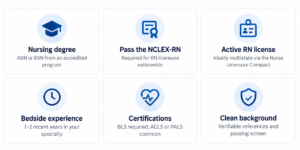
Every staffing agency has its own checklist, but the core travel nurse requirements are consistent across the industry. Skipping any of these will get your application filtered out before a recruiter ever sees it.
Education and Licensing
1. A nursing degree (ADN or BSN)
You need either an Associate Degree in Nursing (ADN) or a Bachelor of Science in Nursing (BSN) from an accredited program. An ADN is the faster, cheaper route, but agencies and hospitals are increasingly favoring BSN-prepared nurses, especially for competitive units like the ICU or ER. If you’re starting from zero, going straight for a BSN will save you from having to backfill it later with an RN-to-BSN bridge program.
2. A passing score on the NCLEX-RN
Before you can call yourself an RN, you have to pass the National Council Licensure Examination, better known as the NCLEX-RN. This is the exam that turns your nursing degree into an actual license to practice, and it’s the same test every RN in the country takes regardless of specialty.
3. An active RN license, ideally a multistate one
Licensing is where travel nursing gets logistically messy. If your home state participates in the Nurse Licensure Compact, you can hold a single multistate license that lets you practice in every other member state without applying for a new one each time. According to the National Council of State Boards of Nursing, most states are now part of the compact, though a handful of larger states, including California and New York, are not, which means you’ll need to apply for an individual license there if an assignment takes you across state lines.
Experience, Certifications, and Background
1. One to two years of recent bedside experience
This is the requirement that catches new grads off guard. Travel nursing is not an entry-level job. Facilities expect you to walk onto the floor and function independently with almost no orientation, so agencies typically require a minimum of one to two years of hands-on experience in your specialty before they’ll even submit your profile. That means your first stop after passing the NCLEX-RN is a staff nursing job, not a travel contract.
2. Specialty certifications
Basic Life Support (BLS) is non-negotiable for every travel nurse. Depending on your unit, you’ll also want Advanced Cardiovascular Life Support (ACLS) or Pediatric Advanced Life Support (PALS). Nurses in high-demand specialties like ICU, ER, OR, and labor and delivery tend to get first pick of the best-paying contracts, so it’s worth specializing early if travel nursing is the long-term goal.
3. A clean background and solid references
Agencies run background checks and drug screens as a matter of course, and they’ll call your previous charge nurse or manager before extending an offer. A messy work history or spotty references will sink an otherwise qualified application faster than a missing certification.
Travel Nurse Requirements at a Glance
| Requirement | Minimum Standard | Why It Matters |
|---|---|---|
| Education | ADN (BSN preferred) | BSN opens more assignments, especially Magnet hospitals |
| Licensure exam | Pass NCLEX-RN | Required for any RN license, no exceptions |
| RN license | Active, ideally multistate (NLC) | Lets you work across compact states without reapplying |
| Clinical experience | 1–2 years in your specialty | Agencies need you working independently on day one |
| Certifications | BLS required; ACLS/PALS common | Higher-acuity units and better pay usually require these |
| Background check | Clean record, verifiable references | Standard step before any agency will submit you |
Do You Need an ADN or BSN to Get Started?
Technically, no. An ADN meets the minimum requirement for RN licensure, and plenty of travel nurses work full careers with one. But “technically allowed” and “practically competitive” are two different things once you start applying.
Here’s the honest breakdown:
- ADN nurses can absolutely get travel contracts, especially in med-surg, long-term care, and facilities that aren’t chasing Magnet status. The degree is faster and cheaper, which matters if you want to start earning sooner.
- BSN nurses have access to a wider pool of assignments. Magnet-designated hospitals, academic medical centers, and many ICU, ER, and OR units specifically request BSN-prepared candidates, and some agencies won’t submit an ADN nurse’s profile to those facilities at all.
- The gap is closing but hasn’t closed. More hospitals are softening BSN-only policies as staffing pressure continues, but if you’re choosing your degree path today with travel nursing as the goal, a BSN keeps every door open instead of some of them.
If you already have an ADN and solid bedside experience, don’t wait to start applying. Many travel nurses complete an online RN-to-BSN program during their contracts, picking up the credential without pausing their income.
How Much Does a Travel Nurse Make?

Pay is the reason most nurses look into travel nursing in the first place, and the numbers genuinely hold up. As of 2026, travel nurses earn an average of somewhere between $101,000 and $148,000 a year depending on specialty, location, and how the agency structures the pay package, which usually blends a taxable hourly wage with tax-free housing and meal stipends. That’s a meaningful premium over the median staff RN salary, which the Bureau of Labor Statistics puts at just over $86,000 a year.
A few patterns worth knowing before you negotiate your first contract:
- Specialty drives pay more than location does. ICU, ER, OR, and cath lab nurses routinely out-earn med-surg travelers by $1,000 or more per week.
- Cost of living cuts both ways. California and New York pay the most, but a chunk of that premium disappears once you account for rent and taxes.
- Crisis contracts pay a spike, not a baseline. Facilities facing sudden shortages will offer eye-popping weekly rates, but these assignments are short and shouldn’t be your only planning strategy.
- Stipends are not guaranteed income. They’re meant to cover housing and meals, so read your contract carefully before treating the whole weekly number as take-home pay.
How to Become a Travel Nurse in 6 Steps
Once you’ve got the requirements sorted out on paper, here’s the realistic order of operations:
- Finish your nursing degree. Choose an accredited ADN or BSN program. If cost or time is a factor, ADN-to-work-to-BSN is a common and perfectly respectable path.
- Pass the NCLEX-RN and get licensed. Apply through your state board of nursing once you’ve completed your program.
- Work the bedside for at least a year. Pick a unit you actually enjoy, since you’ll likely specialize in it for years to come. Use this time to rack up certifications.
- Pick up in-demand certifications. BLS is mandatory; ACLS, PALS, or specialty-specific credentials will make your profile far more competitive.
- Sort out your licensing strategy. If your state is part of the Nurse Licensure Compact, apply for the multistate license early. If not, research the reciprocity process for the states you’d actually want to work in.
- Start applying with agencies once you hit the experience threshold. This is where most of the actual job-hunting effort goes, and it deserves its own breakdown.
How to Get Your First Travel Nurse Job

This is the part most guides gloss over, and it’s the part that actually determines how fast you land an offer.
Get Your Application Ready
Build a travel-ready resume before you need one. Recruiters want to see clear dates, unit type, patient ratios, EHR systems you’ve used (Epic, Cerner, Meditech), and any certifications up front. Vague job titles and missing dates are the fastest way to get passed over.
Apply to more than one agency. Most experienced travelers work with three or four agencies at once because each has access to different facilities and contracts. This isn’t disloyal; it’s standard practice, and it dramatically increases how many assignments you’ll see.
Get your paperwork done before you’re job-hunting, not during. Physical exams, titers, immunization records, and background checks all take time. Having a completed file ready means you can jump on a good contract the moment it appears instead of losing it to someone who was already prepped.
Work the Search Strategically
Be flexible on your first assignment. Highly desirable locations and units get flooded with applicants. If your goal is to break into travel nursing quickly, being open to a less glamorous location for your first 13-week stint will get you in the door faster and give you a track record to leverage for a better second assignment.
Talk to more than one recruiter before committing. A good recruiter will walk you through the entire pay package line by line: base rate, stipends, overtime rules, and guaranteed hours. If a recruiter is vague about numbers or rushes you to sign, treat that as a red flag rather than urgency.
Lean on your references early. Ask your current or most recent manager if they’re willing to serve as a reference before you start applying, not after an agency requests one. A cold call to a manager who wasn’t expecting it can slow your file down by days.
Choosing a Travel Nurse Agency You Can Trust
Not all staffing agencies operate the same way, and the agency you choose affects your pay, your housing, and how smoothly your assignment goes. When comparing options, look for:
- Transparent pay breakdowns. A trustworthy agency will show you the full package in writing, not just a headline weekly number.
- A track record with your specialty. Some agencies specialize in ICU or OR placements; others focus on med-surg or behavioral health. Match the agency to your niche.
- Support during the assignment. Ask what happens if a contract falls through early or if you run into an issue with the facility.
- Housing flexibility. Some agencies provide housing directly; others give you a stipend and let you find your own. Decide which setup actually suits you before you sign.
- Reviews from working travel nurses, not just testimonials on the agency’s own site.
Where to Find Travel Nurse Jobs
Once you know what kind of agency you want, the next question is where you actually see the openings. A few channels cover most of the market:
- Job marketplaces built for travel nursing. Sites like Vivian Health aggregate listings from dozens of agencies in one place, showing pay transparency and agency reviews side by side so you can compare offers for the same assignment across multiple staffing companies.
- Direct agency websites. Larger agencies post openings directly and will often show you jobs their competitors haven’t listed yet, especially for urgent or last-minute contracts.
- Credentialing platforms. Tools like BluePipes let you build one master profile and set of documents that you can send to multiple recruiters at once, which speeds up applications considerably once you’re working with several agencies.
- Referrals from other travel nurses. Facebook groups and nursing forums dedicated to travel nursing are full of people sharing which agencies and recruiters treated them well, and referral bonuses from a fellow traveler can also pad your first paycheck.
- LinkedIn and general job boards. Agencies and independent recruiters post there too, and it’s worth connecting directly with recruiters rather than only applying cold.
Casting a wide net across two or three of these channels at once, rather than relying on a single source, is what actually shortens the time between “I’m ready to travel” and “I have a start date.”
Life on the Road: Pros, Cons, and Realities

Travel nursing looks glamorous from the outside, and a lot of it genuinely is. But it’s worth going in with a clear-eyed view of the trade-offs.
The upsides:
- Significantly higher pay than staff nursing, especially once stipends are factored in
- Control over where and how often you work
- Exposure to different hospital systems, EHR platforms, and patient populations
- A natural way to “try before you buy” a city you’re considering relocating to
The trade-offs:
- No guaranteed long-term benefits like employer-sponsored retirement matching (though many agencies offer their own versions)
- Constant onboarding: new EHR systems, new coworkers, new hospital policies every few months
- Housing and logistics fall on you unless your agency handles it directly
- Maintaining a qualifying “tax home” matters for the tax-free portion of your stipends, and getting this wrong can be costly
What Should You Look for in a Contract?
The weekly pay number on a job listing is just the headline. What actually determines whether a contract is good or bad lives in the details, so read for these before you sign anything:
- Guaranteed hours. Confirm how many hours per week are guaranteed and what happens if the facility cancels a shift; this protects you from a slow census cutting your pay unexpectedly.
- Cancellation and call-off policy. Know how much notice the facility or agency needs to give you (and vice versa) if the contract ends early.
- Overtime and holiday pay rates. These vary a lot by agency and aren’t always volunteered upfront, so ask directly.
- Housing and stipend details. If you’re taking the stipend instead of agency-provided housing, confirm the exact amount and whether it’s based on GSA rates for that location.
- Travel and license reimbursement. Many agencies reimburse travel costs and licensing fees, but only if you ask and it’s written into the contract.
- Extension terms. If you like the assignment, know the process and notice period for extending it before your current contract ends.
- Floating policy. Clarify whether you can be floated to a different unit than the one you were hired for, and if so, how far that can extend from your specialty.
- Start date guarantee. Get the start date in writing. Verbal confirmations can shift, and a delayed start with no compensation is a common frustration for first-time travelers.
A recruiter who answers all of this clearly and puts it in writing is a good sign. One who deflects or rushes you past these questions is worth a second look elsewhere.
Travel Nurse Mistakes to Avoid on Your First Assignment
- Underestimating the experience requirement. Applying before you’ve hit a year of bedside experience wastes your time and the recruiter’s.
- Signing a contract without reading the fine print. Guaranteed hours, cancellation policies, and overtime rules matter more than the headline weekly rate.
- Ignoring your tax home status. Talk to a tax professional who understands travel nursing before assuming your stipends are automatically tax-free.
- Working with only one agency. It limits your options and your negotiating leverage.
- Skipping certifications that would open better contracts. An extra weekend earning ACLS or PALS can pay for itself many times over across a single contract.
Travel Nursing vs. Staff Nursing
If you’re still weighing whether to make the jump, it helps to see the two paths side by side rather than in the abstract.
| Factor | Travel Nursing | Staff Nursing |
|---|---|---|
| Pay | Higher, with tax-free stipends layered on top of base pay | Lower base pay, but steadier and simpler to calculate |
| Benefits | Often limited or agency-provided; no automatic long-term perks | Employer-sponsored health insurance, retirement matching, PTO |
| Job security | Contract-based, typically 8–13 weeks at a time | Ongoing employment with more predictability |
| Flexibility | High control over location, schedule, and time off between contracts | Fixed schedule set by one employer |
| Onboarding | Repeated every few months: new EHR, new team, new policies | One-time, followed by long-term familiarity with the unit |
| Career growth | Broad exposure across facilities and specialties | Deeper relationships and easier path to leadership roles within one system |
| Best fit for | Nurses who want higher pay, variety, and flexibility over stability | Nurses who prioritize consistency, benefits, and long-term team roles |
Neither path is objectively better, and plenty of nurses move between the two more than once over a career. What matters is matching the choice to what you actually want out of this stretch of your working life: income and variety, or stability and continuity.
Key Takeaways
Becoming a travel nurse follows a clear, well-defined path rather than a complicated one. Complete your nursing degree, pass the NCLEX-RN, gain one to two years of bedside experience, secure the certifications relevant to your specialty, and resolve your licensing before approaching an agency. Each step is straightforward on its own; the sequence is what matters.
What ultimately separates a fast placement from a prolonged search is the job search process itself: a well-organized resume, completed paperwork submitted in advance, and a recruiter who provides transparent, itemized pay information rather than a rushed pitch.
Nurses who stay organized and remain flexible about their first assignment location are typically the ones who transition into travel nursing most efficiently. With the requirements met and the right agency relationship in place, the higher earning potential, professional variety, and career growth that make travel nursing appealing are well within reach.